

Yes, web 2.0 sites for backlinks still exist, and you can create links on them for free in minutes. But here is the honest picture: most of these links carry little weight in modern SEO, many are nofollow, and using them as your main link strategy can waste time or even create risk. This guide explains what web 2.0 sites are, whether their backlinks still work, a full list of 30 plus platforms grouped by type, how to use them safely, and what to build instead for links that actually move rankings.
What web 2.0 sites are
Web 2.0 sites are free platforms that let anyone create a page, profile, or mini blog with user generated content. The name comes from the era when the web shifted from static pages to sites where users publish their own material. Think of a free blog on WordPress.com, a page on Medium, or a profile on Tumblr. Because you can add a link back to your own website from these pages, SEOs have long used them to build backlinks quickly and at no cost.
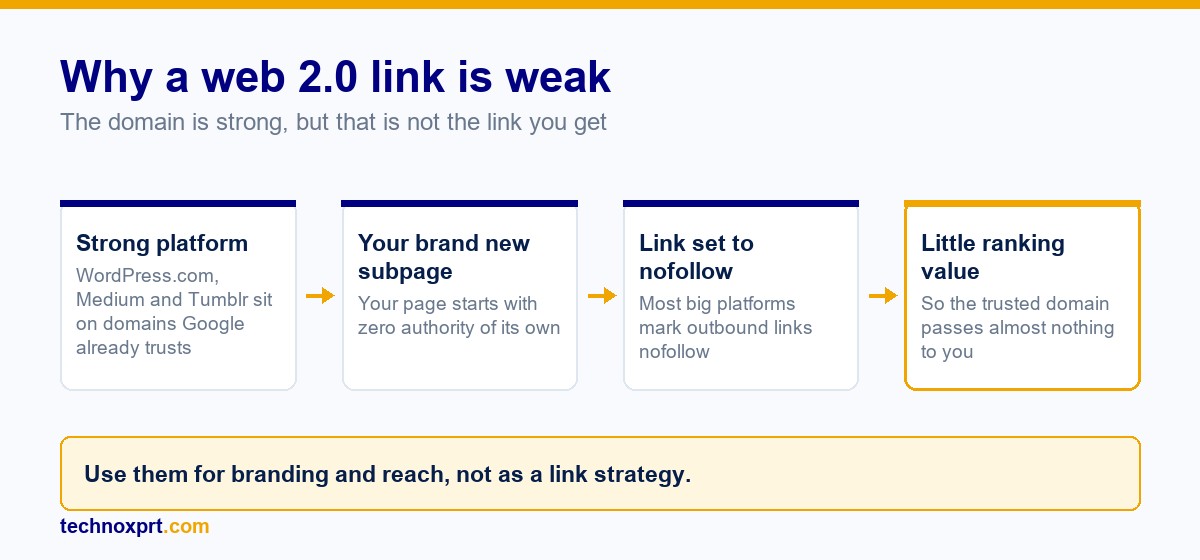
The appeal is obvious. These platforms sit on very strong domains that Google already trusts, they are free, and you control the content you publish. In theory, a link from a high authority domain should pass value. In practice, the reality is more complicated, because the link sits on a brand new subpage with no authority of its own, and the platform often marks outbound links as nofollow.
Do web 2.0 backlinks still work?
The honest answer is that they work a little, in limited ways, and far less than they once did. A decade ago, spinning up dozens of web 2.0 blogs and stuffing them with links could move rankings. Google has since become much better at spotting low quality, manipulative links, so that tactic is mostly dead and can even backfire.
Here is what actually happens with a web 2.0 link today. Most major platforms make outbound links nofollow, which tells Google not to pass ranking credit through them. Even the dofollow ones sit on a fresh page with no authority, so the value passed is small. The domain may be strong, but your specific page is not. That means a single web 2.0 link rarely changes your rankings on its own.
There is also a risk worth naming. Building a large network of web 2.0 blogs that all link to your money site, a tactic called tiered link building, looks unnatural and can be flagged as a link scheme. If you go heavy on this, you trade a tiny short term gain for a real long term risk. The safe view is simple: web 2.0 links are a minor supporting tactic, not a ranking strategy. For links that truly count, see our guide on how to start a link building campaign.
The list: 30 plus web 2.0 platforms by type
Below is a grouped list of popular web 2.0 platforms you can use. Domain authority figures are rough and change over time, so treat them as a general guide to how strong each domain is, not exact numbers. Platform availability was checked in August 2026, and that check is worth repeating yourself before you spend time on any list of this kind, because free publishing platforms close down regularly and outdated lists keep recommending them for years afterwards. Focus on the platforms that also give you a real audience or branding value, not just a link.
Blogging platforms
- WordPress.com (very high authority): free blogs on the most popular platform. Outbound links are usually nofollow.
- Blogger (very high authority): Google’s own free blogging platform, easy to set up.
- Medium (very high authority): clean publishing platform with a built in audience. Links are nofollow.
- Tumblr (high authority): microblogging with a young, creative community.
- Ghost (high authority): modern publishing, better suited to a real blog than link building.
- Substack (high authority): newsletter first publishing with a growing readership.
- LiveJournal (medium authority): an older blogging community still online.
- Weebly blog (medium authority): part of the Weebly site builder.
Site builders
- Wix (very high authority): drag and drop website builder with a free tier.
- Weebly (high authority): simple site builder, free plan available.
- Google Sites (very high authority): free, bare bones site builder from Google.
- Strikingly (medium authority): one page website builder.
- Jimdo (medium authority): easy site builder aimed at small businesses.
- Yola (medium authority): straightforward free website maker.
- Webnode (medium authority): multilingual friendly site builder.
- Site123 (medium authority): quick template based builder.
Publishing and content platforms
- LinkedIn Articles (very high authority): publish long posts to a professional audience.
- Quora (very high authority): answer questions and link where genuinely relevant.
- Reddit (very high authority): community discussion, links are nofollow and spam is removed fast.
- Behance (high authority): portfolio platform for creative work.
- Issuu (high authority): publish digital magazines and documents.
- SlideShare (high authority): share presentations and slide decks.
- Scoop.it (medium authority): content curation platform.
- Bravenet (medium authority): old school free web tools and pages.
- Diigo (medium authority): social bookmarking and annotation.
- Evernote shared notes (high authority): public note pages.
- Penzu (medium authority): online journal platform.
- Postach.io (medium authority): turns notes into a blog.
- Hubpages (medium authority): community publishing platform.
- Zoho Sites (medium authority): site builder within the Zoho suite.
How people use web 2.0 sites safely
Used well, web 2.0 pages have a place, just not as a link farm. The safest uses focus on branding, reach, and support rather than raw ranking power. Publish genuinely useful content on a platform like Medium or LinkedIn to reach a new audience, and link back to your site naturally where it helps the reader. That is content marketing, and it is fine.
Another safe use is indexing and brand presence. Creating a profile on a strong platform can help your brand appear when people search your name, and it gives you another property you control. Some SEOs also use a single, well made web 2.0 property to support a new site, but the key word is single and well made, not fifty thin blogs. Keep the content real, vary your anchor text, and never build a network whose only purpose is to link to yourself. If you would be embarrassed to show the page to a reader, it is not safe.
What to build instead for real links
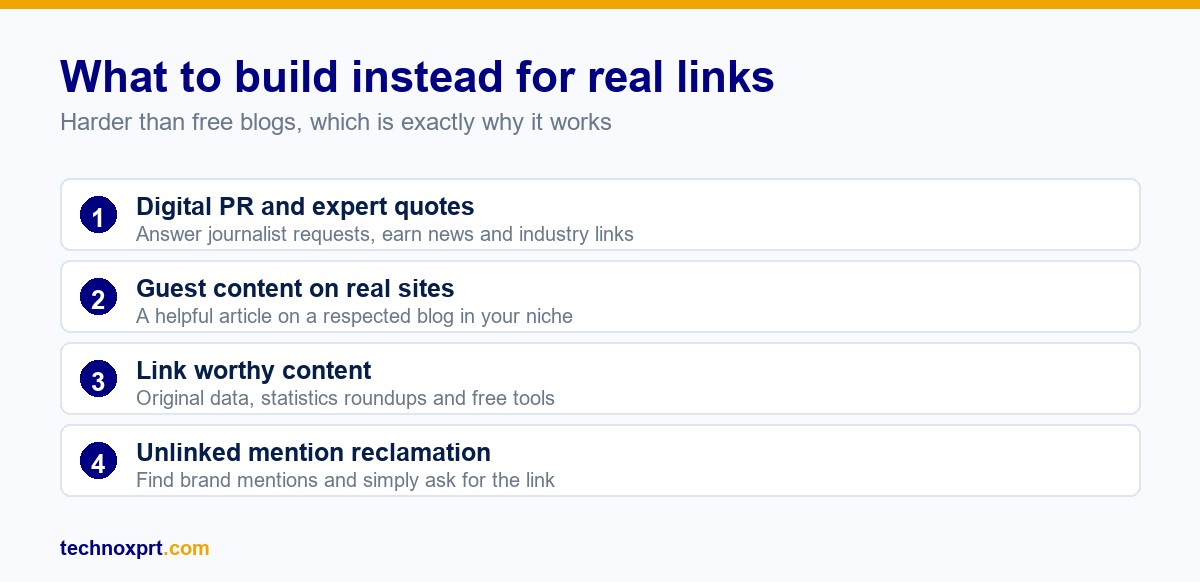
If your goal is links that actually improve rankings, put your energy into earning them from real websites. This is harder than spinning up free blogs, which is exactly why it works. A few links from genuine, relevant sites beat hundreds of web 2.0 links every time.
Start with digital PR and expert quotes. Answer journalist requests on platforms built for that, and you can earn links from real news and industry sites. Guest content is another strong route: write a helpful article for a respected blog in your niche in exchange for a link.
Creating link worthy content, such as original data, statistics roundups, or free tools, gives other sites a reason to cite you naturally. You can also reclaim links by finding unlinked brand mentions and asking for a link. These methods build a link profile that looks natural because it is natural.
To go deeper, read our full guide on how to start a link building campaign, and pair it with the right blogging tools to publish consistently.
What Google actually does with these links
Most writing on this topic warns about penalties. That framing is out of date, and getting it right changes what you should worry about.
Google’s link systems mostly ignore links rather than punish them. A link judged manipulative is usually discounted, and nothing else happens. It simply does not count.
That is why sites running these campaigns rarely report a dramatic collapse. There was no collapse. There was no effect at all.
So the real cost is not risk, it is waste. An afternoon creating eight free blogs and posting thin articles on them buys nothing.
Worse, it competes with the afternoon that would have earned one real link.
Manual actions do still exist, and they target patterns rather than individual links: networks built for no purpose except linking, at scale, with obvious footprints.
A handful of profiles on public platforms is not that. Forty auto generated blogs cross referencing each other on the same hosting is exactly that.
Which also settles the disavow question. If bad links are ignored rather than counted against you, there is usually nothing to disavow.
Keep the tool for the case where you actually have a manual action naming links. Outside that, it solves a problem you probably do not have.
The honest verdict
Web 2.0 sites are free, easy, and still online, but they are a weak link building tactic in 2026. Most links are nofollow or sit on pages with no authority, and building them at scale risks looking like a link scheme. Use a small number for branding, reach, and indexing, publish real content on the strong platforms, and spend your real effort earning links from genuine websites. That is the path that actually grows your rankings and protects your site.
Frequently asked questions
Are web 2.0 backlinks safe?
A few web 2.0 links used for branding and real content are safe. The risk comes from building them at scale, with a large network of thin blogs that all link to your site using exact match anchors. That pattern can be flagged as a link scheme. Keep it small, keep the content genuine, and web 2.0 links are safe but low value.
Are web 2.0 links dofollow?
Most major web 2.0 platforms make outbound links nofollow, including Medium, Tumblr, Reddit, and Quora, which means they do not pass normal ranking credit. Some smaller platforms allow dofollow links, but those pages usually have little authority. Do not assume a link is dofollow just because the domain is strong, since the setting is what matters.
Do web 2.0 sites help SEO?
They help a little and indirectly. Web 2.0 pages can support branding, reach a new audience, and help your brand appear in search, but a single web 2.0 link rarely improves rankings on its own. For real SEO gains, earn links from genuine websites through guest content, digital PR, and link worthy content rather than relying on free platforms.
How many web 2.0 backlinks should I make?
There is no magic number, and more is not better. A handful of well made properties on strong platforms, with real content, is far safer and more useful than dozens of thin blogs. If you are creating them only to link to yourself in bulk, you are taking on risk for little reward. Focus on quality and stop chasing volume.
What is a web 2.0 site example?
Common examples include WordPress.com, Blogger, Medium, Tumblr, Wix, and Weebly. These are all free platforms where anyone can publish content and add a link back to their own site. They sit on strong domains, but the individual pages you create start with no authority, which is why their link value is limited.
Will web 2.0 backlinks get my site penalised?
Usually not, because Google mostly ignores links it judges manipulative rather than punishing them. The link is discounted and nothing else happens, which is why these campaigns rarely produce a visible drop, there was no effect either way. The real cost is wasted effort rather than risk. Manual actions do exist but target patterns, such as networks of sites built purely for linking at scale, not a few profiles on public platforms.
Do I need to disavow web 2.0 links?
Almost certainly not. If Google ignores manipulative links rather than counting them against you, there is nothing to disavow, and the tool is not the routine maintenance it is often presented as. Keep it for the specific case where you have a manual action that names links.