

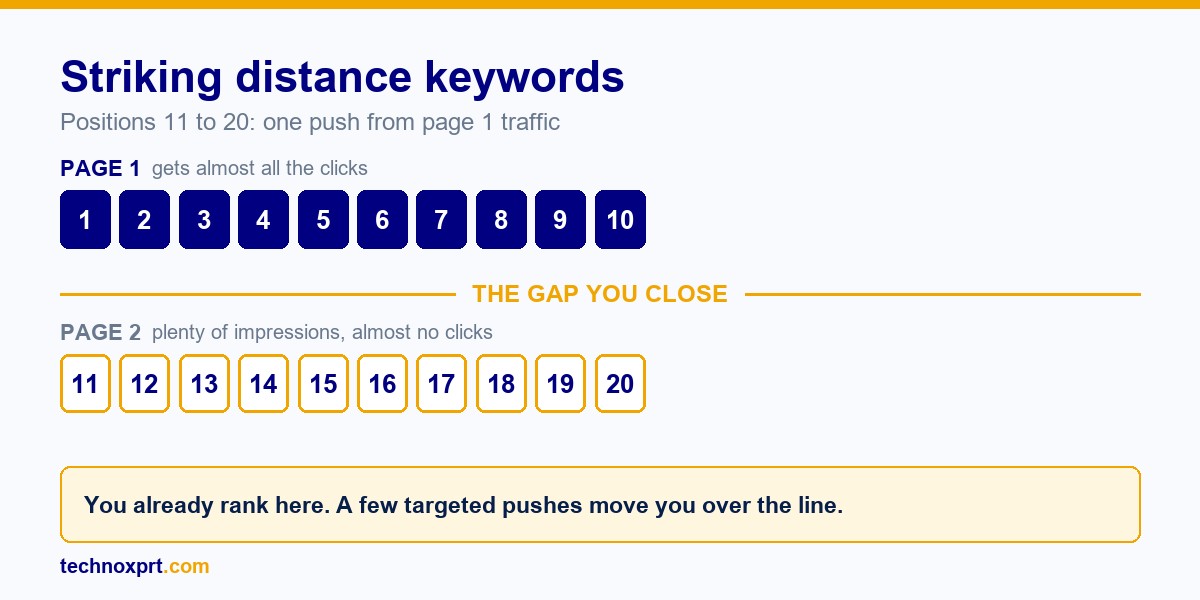
Striking distance keywords are the terms your site already ranks for in positions 11 to 20, sitting just off the first page of Google. They are one small push from real traffic, since page 2 gets almost no clicks while page 1 gets nearly all of them. That tiny gap is why these keywords are the highest return work in SEO. This guide shows how to find your striking distance keywords and the exact pushes that move a page from page 2 to page 1.
Why striking distance keywords are the highest ROI work in SEO
The math is simple and compelling. When you target a brand new keyword, you start from nothing and have to climb the entire way, which takes months and plenty of effort. A striking distance keyword is different: Google already understands your page and ranks it, it is just on page 2. You are not building from scratch, you are nudging something that already works over the line.
Because the hard part is done, the effort to reward ratio is excellent. Moving a page from position 14 to position 8 can multiply its traffic, since click through rates jump sharply once you cross onto page 1. You are capturing traffic that is almost within reach rather than chasing rankings that may take a year. For any site with some history, working your striking distance keywords first is the fastest, most efficient way to grow, which is why experienced SEOs start here.
How to find them in Google Search Console step by step
Google Search Console is free and shows your real ranking data, which makes it the best place to find striking distance keywords. Here is the step by step workflow.
First, open the Performance report and make sure both Average position and Total impressions are toggled on. Second, set the date range to the last three months for a stable picture. Third, go to the Queries tab and add a filter on position, showing only queries where average position is greater than 10.
Add a second filter for position less than 21, so you are left with positions 11 to 20. Fourth, sort the remaining queries by impressions, highest first, so the keywords with the most potential traffic rise to the top. What you now have is a ready made list of striking distance keywords, ranked by opportunity: terms you already rank for on page 2, ordered by how many people are searching them.
Export this list and you have your work queue. This GSC workflow is the heart of the process, since it uses your real data rather than guesses.
How to find them in Ahrefs or Semrush
If you use a paid tool, you can find striking distance keywords there too, which is handy for tracking and extra data. In Ahrefs, open Site Explorer for your domain, go to Organic keywords, and filter positions from 11 to 20. In Semrush, open the Organic Research positions report for your domain and filter the position range to 11 to 20 in the same way.
Both let you add filters for volume and sort by traffic potential, and both show extra context like keyword difficulty and the ranking URL. The advantage over Google Search Console is richer competitive data and easier ongoing tracking, though the core idea is identical. Whichever route you use, the output is the same: a prioritized list of near miss keywords to push onto page 1.
To compare these tools, see our guide to Ahrefs vs Semrush vs Ubersuggest.
The 6 pushes that move a page from page 2 to page 1
Once you have your list, these are the six moves that most often close the gap. Apply the ones that fit each page.
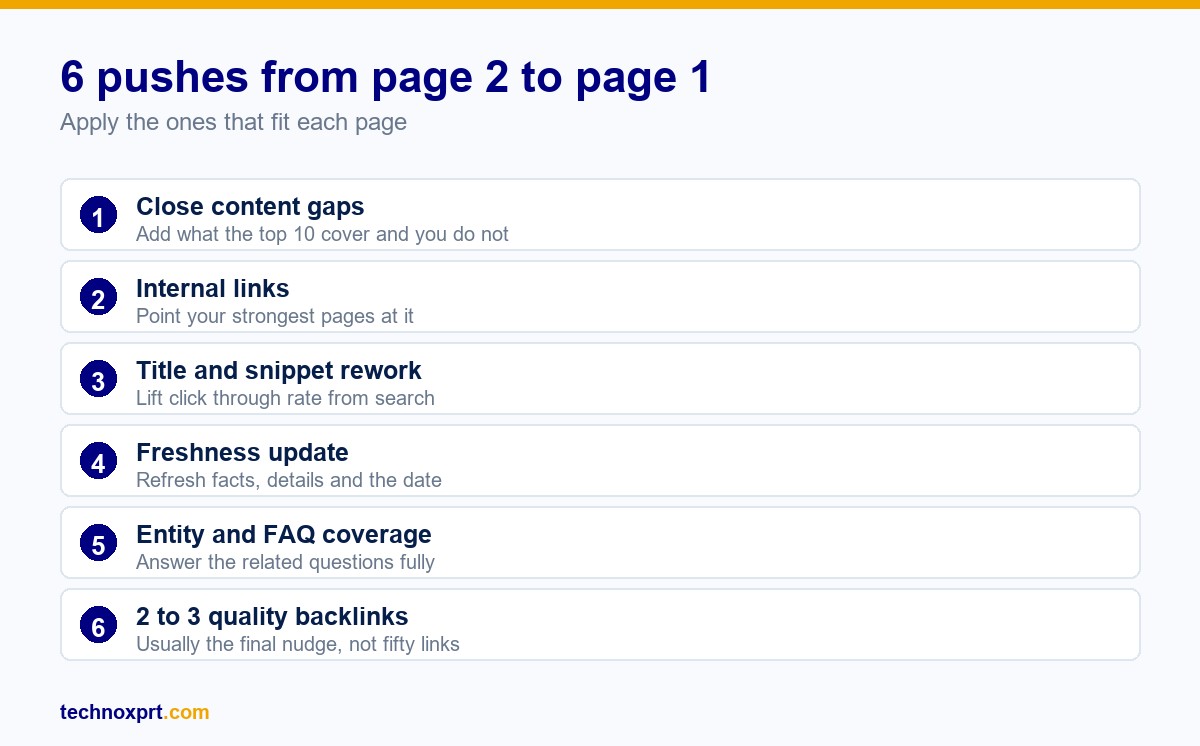
- Close content gaps versus the top 10: Look at the pages currently ranking on page 1 for your keyword and note what they cover that you do not. Add the missing subtopics, depth, and answers so your page becomes the more complete resource.
- Add internal links from strong pages: Find your most authoritative existing pages and link to the striking distance page from them, using natural, relevant anchor text. This passes authority to the page that needs a boost.
- Rework the title and snippet for CTR: A more compelling title and meta description can lift clicks, and higher click through rates from search can help rankings. Make the title match intent and stand out.
- Update for freshness: Refresh the content with current information, a recent date, and new details. Google often rewards updated, relevant pages, especially for topics where freshness matters.
- Improve entity and FAQ coverage: Add clear answers to related questions and cover the key entities and terms associated with the topic, which helps Google understand your page fully and match more queries.
- Earn two or three quality backlinks: A small number of relevant links to the page can provide the final nudge. You rarely need many, since the page is already close. For how to earn them, see our guide on how to start a link building campaign.
Prioritizing when you have 50 striking distance keywords
Most sites find far more striking distance keywords than they can work at once, so prioritization matters. Score each keyword on three factors and tackle the highest scoring first. Volume tells you how much traffic is at stake, so higher search volume keywords are more valuable to push.
Relevance tells you how well the keyword matches your business or content goals, since ranking for a term that brings the right visitors beats a bigger term that does not convert. Current position tells you how close you are, so a keyword at position 11 or 12 is a quicker win than one at 19. A simple approach is to multiply or weigh these together: high volume, highly relevant keywords sitting at the top of page 2 are your best first targets.
Work down the list from there, and you spend your effort where it pays off fastest.
A real example walkthrough
Here is the pattern this work follows, walked through end to end. Take a blog post ranking at position 14 for a keyword with a few thousand monthly searches, bringing only a trickle of traffic because it sat on page 2. Checking the top 10, the page was missing a comparison section and answers to two common questions its competitors covered.
The fixes were straightforward: add the missing comparison and FAQ content, refresh the intro and date, rework the title to better match what searchers wanted, and add three internal links from stronger related posts. No new backlinks were needed. The realistic outcome is a move onto the bottom of page one within a few weeks, and a click count that rises sharply rather than gradually, because crossing from page two to page one is a step change rather than an incremental one.
Nothing here was dramatic; it was a focused set of small pushes on a page that was already close, which is exactly what striking distance work rewards.
Two reasons a page sits at 14 that more content will not fix
The six pushes above assume the page is close because it is slightly weaker than the ones above it. Two other causes look identical in the report and do not respond to the same treatment.
The first is competing with yourself. If two of your own pages target the same query, Google picks one and often splits the signals between them, which can park both in the teens indefinitely.
Check before you optimise: search your site for the query with the site: operator. If two of your pages come back trying to answer it, adding content to one of them makes the problem worse, not better. The fix is to merge them and redirect.
The second is intent mismatch. Sometimes a page is at 14 because it is the wrong kind of page for the query, and no amount of improvement moves it.
Look at what actually ranks in the top ten. If they are all comparison pages and yours is a how to guide, you are not slightly behind them, you are answering a different question.
That is a decision about whether to write the right page, not an optimisation of the wrong one, and it is far better to know that before spending an afternoon on it.
A quick way to tell the two apart from the third case, a page that genuinely just needs the six pushes: look at whether your impressions are healthy while clicks are poor.
Healthy impressions mean Google is showing you for the query and readers are choosing someone else, which the pushes fix. Low impressions mean Google does not think you belong there, which they do not.
What to expect from this in 2026
One honest adjustment to the promise, because the maths behind striking distance work has shifted slightly.
Moving from page two to page one is still the highest return work available. Page two gets almost no clicks, so the jump remains a step change rather than an improvement.
But the top of page one is not what it was. On queries where an AI summary appears, a share of the answer is given before anyone reaches the results, so arriving at position eight earns less than position eight used to earn.
That does not make this work less worthwhile. It makes the comparison against writing new content even more favourable, because a new page faces the same reduced clicks and has to earn its position from nothing first.
It does change which keywords to prioritise. Among your striking distance list, favour the queries where a summary is less likely to satisfy the reader outright.
Comparisons, purchase decisions and anything needing your specific data or opinion still send clicks. Simple factual questions increasingly do not, whatever position you reach.
You can check this in a minute per keyword by searching it and looking at what sits above the results, which is worth doing before choosing which ten pages to work on.
How to run this every month
Striking distance keywords are the smartest place to start if your site has any ranking history, because the hardest work is already done and a few targeted pushes can turn near misses into real traffic. Find them in Google Search Console or your SEO tool, prioritize by volume, relevance, and current position, then apply the six pushes to each page. Track your results and repeat the process regularly, since new striking distance keywords appear as your site grows. It is the highest return routine in SEO, and it compounds over time.
Frequently asked questions
What does striking distance mean in SEO?
In SEO, striking distance refers to keywords your site ranks for in positions 11 to 20, meaning page 2 of Google, just outside the first page. These keywords are close to breaking onto page 1, where the vast majority of clicks happen. Because Google already ranks your page, a few improvements can push it over the line, making these the highest value keywords to work on.
Why is my page stuck on page 2?
A page often sticks on page 2 because it is close but missing something the top 10 pages have, such as fuller content, stronger internal links, better matching of search intent, freshness, or a few quality backlinks. Google sees it as relevant but not quite the best answer. Identifying and closing that gap with the right pushes is usually what moves it onto page 1.
How long does it take to move from page 2 to page 1?
It varies, but because the page already ranks, improvements often show results within a few weeks rather than months. Simple fixes like content updates and internal links can move a page quickly, while adding backlinks takes longer to have an effect. Competitive keywords take more time than easy ones, so expect anywhere from a couple of weeks to a few months.
Do I need backlinks to reach page 1?
Not always. Many striking distance keywords reach page 1 through on page improvements alone, such as closing content gaps, adding internal links, and improving freshness and intent match. Since the page already ranks on page 2, it may need only a small nudge. Backlinks help for competitive terms, but a few quality links, not many, are usually enough when needed.
How many impressions do page 2 rankings get?
Page 2 rankings get plenty of impressions, since they still appear in search results, but very few clicks, because most users never go past page 1. This gap is exactly why striking distance keywords are so valuable: the demand is already there in impressions, and pushing onto page 1 converts those impressions into actual clicks and traffic.
Why is my page stuck on page 2 even after optimising it?
Usually one of two reasons the report cannot show you. Either two of your own pages target the same query, splitting the signals between them, which you can check with a site: search and fix by merging and redirecting rather than adding more content. Or the page is the wrong type for the query, which you spot by looking at what actually ranks in the top ten. Healthy impressions with poor clicks means the usual fixes will work, while low impressions mean Google does not think the page belongs there.
Are striking distance keywords still worth chasing with AI Overviews?
Yes, and arguably more so. Page two gets almost no clicks, so moving to page one remains a step change rather than an improvement. AI summaries do mean a given position earns less than it used to, but that applies equally to new content, which has to earn its position from nothing first. It does change prioritisation: favour queries where a summary is unlikely to satisfy the reader outright, such as comparisons and purchase decisions, over simple factual questions.