

In the Ahrefs vs Ubersuggest question, with Semrush added to the mix, here is the quick verdict: Ahrefs is best for backlinks and serious SEO, Semrush is best as an all in one marketing platform, and Ubersuggest is best for budget beginners. All three do keyword research, rank tracking, and audits, but they differ sharply on data depth, features, and price. This full comparison breaks down where each tool wins so you can pick the right one for your work and budget.
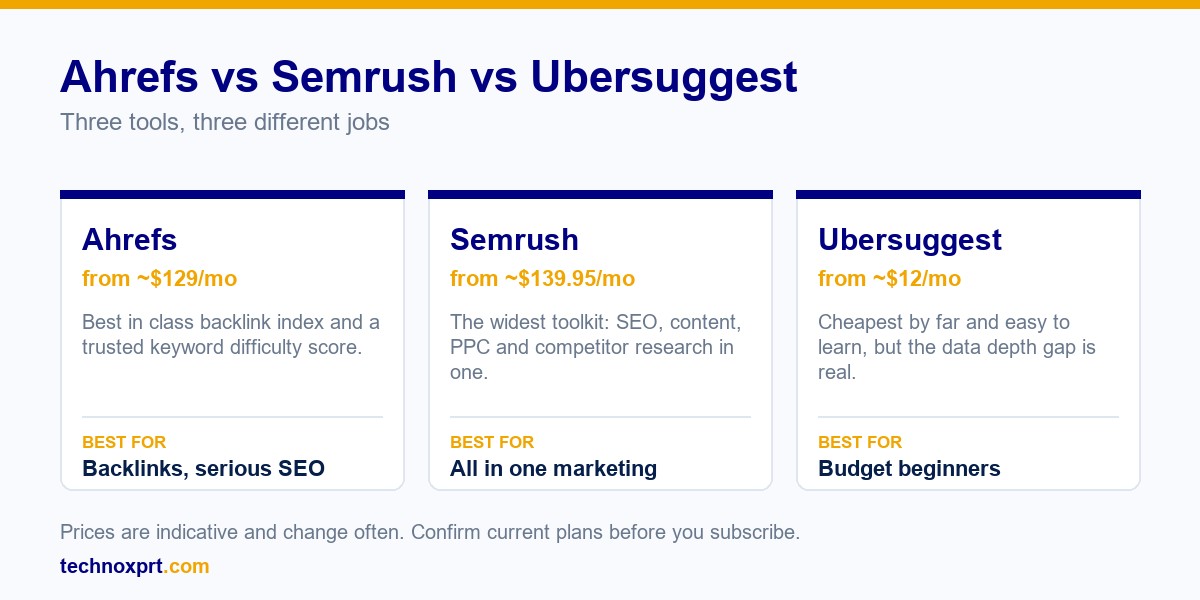
Ahrefs vs Semrush vs Ubersuggest: comparison table
| Feature | Ahrefs | Semrush | Ubersuggest |
|---|---|---|---|
| Starting price | Around $129/mo | Around $139.95/mo | Around $12/mo or lifetime |
| Keyword database | Very large | Largest, global | Smaller |
| Backlink index | Best in class | Excellent | Basic |
| Site audit | Strong | Deepest | Simple |
| Rank tracking | Good | Good | Good, limited |
| Content tools | Limited | Extensive | Basic |
| Free plan reality | Webmaster tools only | Very limited | Limited daily searches |
| Best for | Backlinks, serious SEO | All in one marketing | Budget beginners |
Prices and features change often, so confirm the current details on each tool’s site before you subscribe.
Ahrefs strengths and weaknesses
Ahrefs built its reputation on backlink data, and it still leads there. Its backlink index is among the largest and freshest available, so if link analysis, competitor link research, and finding link opportunities matter to you, Ahrefs is the strongest of the three. Its keyword tools are excellent too, with a huge database and one of the most trusted keyword difficulty scores in the industry, which many SEOs rely on to judge how hard a term is to rank for.
Beyond links and keywords, Ahrefs offers a solid site audit, reliable rank tracking, and a clean, fast interface that professionals appreciate. Its content explorer is useful for finding popular pages and content ideas in your niche. The tool feels built by SEOs for SEOs, with data quality as its top priority.
The weaknesses are real too. Ahrefs has fewer content and marketing extras than Semrush, so it is less of an all in one platform. It has no meaningful free tier beyond its free Webmaster Tools for your own verified site, and pricing starts around $129 per month, which is steep for beginners. Historically it also limited some actions on lower plans, and heavy users can run into usage caps that push them to more expensive tiers. There is also a learning curve, since the depth of data can feel dense until you know where to look.
That said, most serious SEOs consider these fair trades for the quality of the data. If your work lives and dies by backlinks, competitor research, and keyword difficulty you can trust, Ahrefs repays its price quickly. For pure SEO and backlinks, it is hard to beat, and it sits among the top picks in our roundup of the best SEO tools.
Semrush strengths and weaknesses
Semrush is the most complete platform of the three, and that breadth is its biggest strength. It combines keyword research, one of the largest global keyword databases, deep competitor analysis, an excellent site audit, rank tracking, and a full suite of content, PPC, and even social and local tools. If you run SEO, paid ads, and content together, or manage several clients, Semrush can replace several separate tools with one login, which often justifies its cost.
Its data depth is strong across markets, and its keyword gap and competitor tools are among the best for research at scale. The content marketing toolkit, including topic research and a writing assistant, is more developed than anything Ahrefs or Ubersuggest offers, making Semrush a favorite for content led teams.
The downsides are price and complexity. Semrush starts around $139.95 per month, the highest of the three, and extra seats or historical data cost more, so the real cost for a small team can climb quickly. Its huge feature set can feel overwhelming for a beginner who only needs the basics, and much of its value goes unused by light users. Some limits, such as the number of tracked keywords and reports per day, also apply on the entry plan, which can pinch as you grow.
None of this makes Semrush a poor choice; it simply means the tool rewards users who actually use its breadth. For a solo blogger, that breadth may be more than they need, but for agencies and serious marketing teams juggling SEO, content, and ads, Semrush is a genuine powerhouse that earns its keep. See how it compares against a budget rival in our Semrush vs Serpstat guide.
Ubersuggest strengths and weaknesses
Ubersuggest’s biggest strength is simple: it is cheap and easy. It offers keyword research, basic rank tracking, site audits, and content ideas at a fraction of the price of Ahrefs or Semrush, with plans starting around $12 per month and a lifetime purchase option that appeals to budget users. Its interface is clean and beginner friendly, so newcomers can start doing keyword research within minutes without feeling lost.
For bloggers, small business owners, and anyone learning SEO, Ubersuggest covers the essentials well enough to make progress. It gives you keyword ideas, difficulty estimates, and content suggestions in one affordable place, which is genuinely useful when you are starting out and cannot justify a premium subscription.
The honest weakness is data depth. Ubersuggest’s keyword and backlink databases are smaller than those of Ahrefs and Semrush, and its difficulty and volume figures can be less accurate, especially for competitive research. Its site audit and backlink tools are basic compared with the premium platforms, and its lower plans cap daily searches, which can frustrate heavier users. For deep competitor analysis or serious link building, it simply does not have the index size to compete.
Still, none of that erases its value for the right person. It is a fine starting tool that lets beginners learn SEO without a painful monthly bill, and many users happily stay on it for basic blogging work. Others outgrow it as their SEO gets more serious, which is natural. If you have hit its limits, our guide to Ubersuggest alternatives covers your next step, including free options.
Data accuracy check: the same three domains in all three tools
The best way to judge these tools is to run the same domains through all three and compare. In a fair test, you would pick three websites, one large, one medium, and one small, then check each tool’s reported keyword volumes, keyword difficulty, backlink counts, and organic traffic estimates for the same domains, side by side. Screenshot placeholders below would show those results for full transparency.
What you typically find is instructive. Ahrefs and Semrush usually report similar, higher backlink counts because their indexes are larger, while Ubersuggest shows fewer links since its crawl is smaller. Keyword volumes often differ across all three, since each estimates them differently, which is a reminder that these numbers are estimates, not exact truths. Ahrefs and Semrush tend to agree more closely with each other than with Ubersuggest, particularly on competitive keywords and link data.
The differences are usually widest on two things: total backlinks and keyword difficulty. Because link discovery depends entirely on how much of the web a tool crawls, the premium tools naturally surface more referring domains, which can change how strong a competitor looks. Keyword difficulty scores are calculated with each tool’s own formula, so the same keyword can read as easy in one tool and hard in another, which matters a lot when you are deciding what to target. Organic traffic estimates diverge too, since they are modeled from rankings and volumes that already differ.
The practical takeaway is that for high stakes decisions you want the deeper data of Ahrefs or Semrush, while Ubersuggest is close enough for basic, everyday research. Do not treat any figure as gospel; use them to compare options and spot trends, not as exact measurements. Whichever tool you use, confirm your real performance in Google Search Console rather than trusting any single tool’s numbers.
Pricing per feature: what each dollar buys
The price gap makes more sense when you break it down by what you get. With Ahrefs, your money buys the best backlink data and a trusted keyword toolset, but fewer marketing extras, so heavy link and keyword users get strong value while content marketers may feel something is missing. With Semrush, you pay the most but get the widest toolkit, so if you use the content, PPC, and competitor tools alongside SEO, the cost per job drops because one tool replaces several. If you only need basic SEO, much of that value sits unused.
With Ubersuggest, you pay very little and get the core of SEO research, plus the appeal of a lifetime option that avoids monthly fees entirely. You give up data depth, index size, and advanced features. The honest way to choose is to list the features you will actually use each week. If that list is deep backlinks and keyword research, Ahrefs earns its price. If it spans SEO, content, and PPC, Semrush is worth the premium. If it is basic keyword ideas on a tight budget, Ubersuggest wins on value.
It also helps to think in cost per outcome rather than sticker price. A freelancer who lands one client from better keyword research has more than covered an Ahrefs subscription, while a hobby blogger who checks a few keywords a month would struggle to justify it. The most expensive tool is the one you pay for but barely use, so be honest about your workload before choosing. Trialing each tool on your own site for a week is the surest way to see which one you actually reach for.
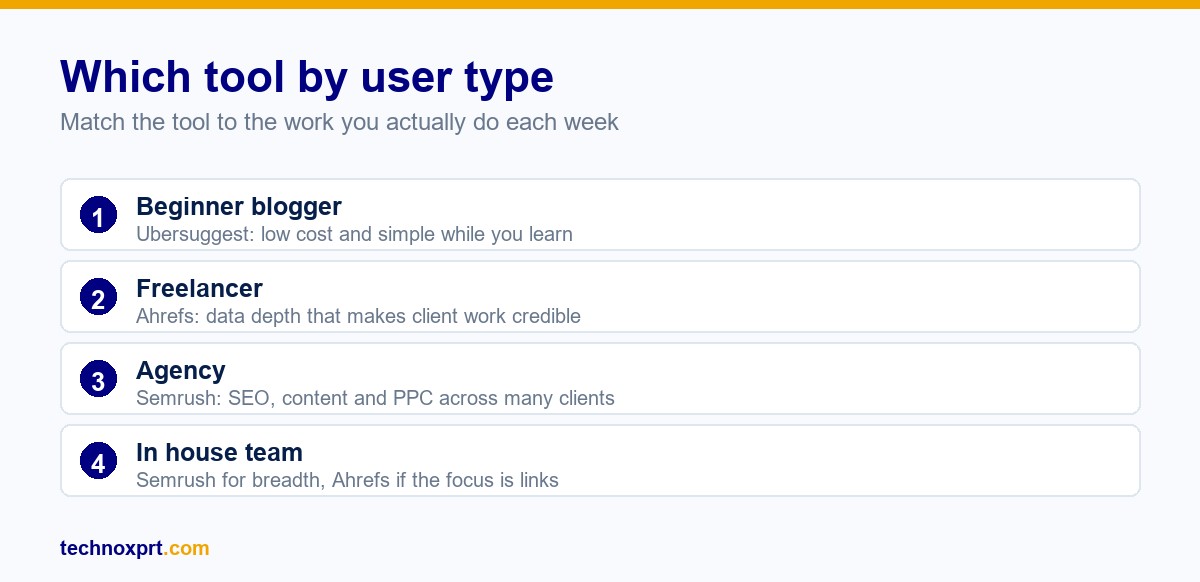
Which to pick by user type
- Beginner blogger: Ubersuggest, for its low cost, simple interface, and lifetime option while you learn the ropes.
- Freelancer: Ahrefs, for the data depth and backlink tools that make client work credible, if the budget allows.
- Agency: Semrush, for the all in one toolkit that handles SEO, content, and PPC across many clients from one place.
- In house marketing team: Semrush for breadth, or Ahrefs if your focus is squarely on SEO and links rather than wider marketing.
Many people start on Ubersuggest and move up to Ahrefs or Semrush as their needs grow, which is a sensible path that keeps early costs low. For more head to head comparisons, see our guides to SpyFu vs Ahrefs and SpyFu vs Semrush vs Moz.
Verdict
There is no single winner, only the right fit for your goals and budget. Choose Ahrefs if backlinks and serious SEO are your priority and you want the best link data available. Choose Semrush if you want one platform to handle SEO, content, and marketing together, and you will use the breadth.
Choose Ubersuggest if you are a beginner or on a tight budget and need the essentials at the lowest cost. Decide by the features you will actually use each week, test the data on your own domains, and confirm current pricing before you commit, since plans change. Remember too that the best tool is the one you will genuinely use, so match the choice to your real workflow rather than to whichever name has the biggest reputation.
Frequently asked questions
Is Ubersuggest as good as Ahrefs?
Ubersuggest is not as deep as Ahrefs, especially for backlink data and competitive keyword research, where Ahrefs has a far larger index and more trusted metrics. However, Ubersuggest is much cheaper and covers the basics of keyword research and audits well. For beginners and budget users it is good enough, but serious SEOs usually prefer the data depth of Ahrefs.
Which is cheapest, Ahrefs, Semrush, or Ubersuggest?
Ubersuggest is by far the cheapest, with plans starting around $12 per month and a lifetime purchase option, compared with roughly $129 for Ahrefs and $139.95 for Semrush. The tradeoff is smaller databases and fewer advanced features. If budget is your main concern, Ubersuggest wins clearly, while Ahrefs and Semrush cost more but offer far greater depth.
Is the Ubersuggest lifetime deal worth it?
The Ubersuggest lifetime deal can be worth it for beginners and small site owners who want to avoid monthly fees and only need basic keyword research and audits. It is a low risk way to own an SEO tool long term. However, if you need deep backlink data or advanced features, the lifetime deal will not match what Ahrefs or Semrush provide, so weigh your real needs first.
Can I use the free versions only?
You can do some work with free access, but it is limited. Ahrefs offers free Webmaster Tools for your own verified site, Semrush has a very limited free account, and Ubersuggest allows a few free searches per day. Combined with free tools like Google Search Console and Keyword Planner, this can support basic SEO, but serious research needs a paid plan on at least one tool.
Which tool has the most accurate data?
Ahrefs and Semrush generally have the most accurate and complete data, thanks to their large indexes, and they often agree closely with each other, especially on backlinks and competitive keywords. Ubersuggest is less precise due to its smaller database. That said, all search volumes are estimates, so confirm your real results in Google Search Console rather than trusting any single tool.